
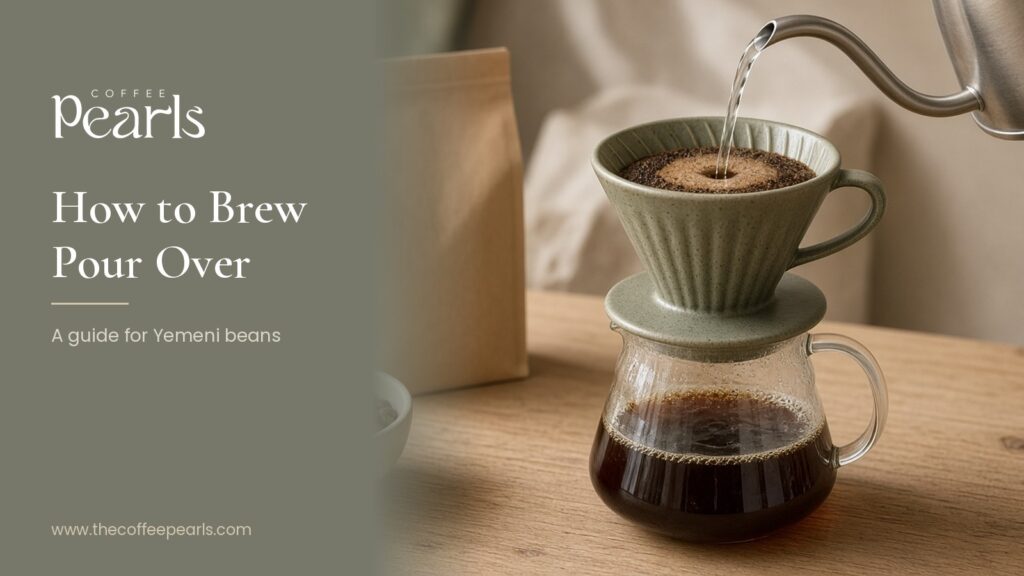
Pour over is one of the simplest ways to brew coffee by hand, and one of the most rewarding. With a cone, a paper filter and a kettle, you control every part of the brew: how fine the coffee is ground, how hot the water is and how slowly you pour. That control is exactly why pour over suits single-origin beans like Yemeni coffee, whose character can get lost in milk or a rushed brew.
This guide walks you through the equipment, a reliable starting recipe, a step-by-step method and the small adjustments that make the biggest difference. It is written for coffee lovers in the UAE brewing at home, and it works just as well in an office pantry or a small café counter.
What Is Pour Over Coffee?
Pour over is a filter brewing method. Hot water is poured by hand over ground coffee sitting in a paper filter, and it drips through into a cup or server below. Popular drippers include the cone-shaped V60, flat-bottom drippers such as the Kalita Wave, and the Chemex, which combines dripper and carafe in one glass piece.
Because the paper filter holds back most of the oils and fine particles, pour over usually tastes clean and clear. Sweetness, fruit and caramel-like notes come forward, which makes it a natural match for carefully grown, carefully roasted beans.
What You Need
- A dripper: a V60, Kalita Wave, Chemex or any cone you already own.
- Paper filters that fit your dripper.
- Freshly roasted whole beans and a burr grinder, or beans ground for filter when you buy them.
- A kettle. A gooseneck kettle gives the most control, but a regular kettle works if you pour slowly.
- A digital scale for weighing coffee and water. It is the single most useful tool for consistent results.
- A mug or server and a timer (your phone is fine).
A Reliable Starting Recipe
Most pour over recipes use a coffee-to-water ratio of around 1:15 to 1:17. A good place to start for one generous cup:
- Coffee: 15 g, ground medium-fine (roughly like coarse sand).
- Water: 250 g, just off the boil, about 92 to 96°C.
- Total brew time: roughly 2.5 to 3.5 minutes.
For two cups, simply double the numbers: 30 g of coffee to 500 g of water, and expect the brew to take a little longer.
Step-by-Step: How to Brew Pour Over Coffee
1. Heat the water and rinse the filter
Bring your water to the boil and let it rest for about 30 seconds. Place the filter in the dripper, set it on your mug or server, and rinse the paper with hot water. This removes any papery taste and warms everything up. Pour away the rinse water.
2. Grind and level the coffee
Grind 15 g of coffee just before brewing if you can, since ground coffee loses aroma quickly. Tip it into the filter, give the dripper a gentle shake to level the bed, and put everything on the scale. Tare it to zero.
3. Bloom
Start the timer and pour about 30 to 40 g of water, enough to wet all the grounds evenly. You will see the coffee bubble and rise as gas escapes from freshly roasted beans. Wait 30 to 45 seconds. This bloom helps the rest of the water extract flavour evenly.
4. Pour in slow circles
Pour the rest of the water slowly in small circles, working from the centre outwards and back, avoiding the paper edges. You can pour it all in one steady stream or in two or three stages, for example up to 150 g, pause, then up to 250 g. Keep the water level fairly steady rather than flooding the cone.
5. Let it drain and serve
When you reach 250 g, let the water drain through. Give the dripper a gentle swirl to flatten the coffee bed. The brew should finish at around 2.5 to 3.5 minutes. Remove the dripper, swirl the coffee and let it cool for a minute or two: many of the sweeter, more delicate notes become easier to taste as the cup cools a little.
How to Adjust the Taste
Your first cup is a starting point. Change one thing at a time and taste the difference:
- Sour, thin or sharp? The coffee is likely under-extracted. Grind a little finer or use slightly hotter water.
- Bitter, dry or harsh? It is likely over-extracted. Grind a little coarser or pour a bit faster.
- Too strong or too weak? Adjust the ratio: more water for a lighter cup, less for a stronger one.
- Brew taking far too long? The grind is probably too fine, or the pour is too heavy in the centre.
Also remember that water matters. Coffee is mostly water, so a neutral, good-tasting bottled or filtered water will give a cleaner cup than very hard tap water.
Brewing Yemeni Beans as Pour Over
Yemeni coffee is grown on terraced mountain farms and is traditionally sun-dried as whole cherries, which gives many Yemeni lots a deep, rounded character. Pour over is a lovely way to taste those differences between regions. You can read more about them in our guide to the bold flavours of Yemeni coffee beans.
Kholani
Our Kholani beans come from the Khawlan highlands. They have a gentle caramel note, so a slightly finer grind and a calm, steady pour bring that sweetness forward. Try the standard 1:16 recipe first.
Matari and Harazi
Matari and Harazi coffees come from the Bani Matar and Haraz mountain areas west of Sana’a. If a cup tastes heavy, try a slightly coarser grind or a ratio closer to 1:17 for a clearer, lighter brew.
Whatever the origin, check the roast date on the bag. Many brewers prefer to use beans from about a week after roasting, once the strongest gas has settled, and to finish the bag within a few weeks of opening. Store beans in an airtight container away from heat and sunlight.
Pour Over at the Office or on the Go
Pour over takes a few minutes and a little attention, which makes it a nice ritual for a quiet morning. On busy workdays, drip bag coffee gives you a similar filter-style cup with no equipment at all: the ground coffee comes in its own hanging filter, so you just add hot water. Capsules are another fast option for offices that already have a compatible machine.
For cafés, hotels and offices that want to serve Yemeni filter coffee, whole beans for pour over and batch brewers are available for business orders.
Frequently Asked Questions
What grind size is best for pour over?
Start with a medium-fine grind, similar to coarse sand or table salt. Then adjust finer or coarser depending on taste and brew time.
Can I make pour over without a scale?
Yes. About two level tablespoons of ground coffee for a 250 ml cup is a rough guide. A scale simply makes it easier to repeat a cup you enjoyed.
Do I need a gooseneck kettle?
It helps, because it gives you a slow and precise pour, but it is not essential. With a regular kettle, pour gently and in small amounts.
Is pour over the same as drip bag coffee?
Both are filter methods, so the style of cup is similar. Pour over gives you more control over each variable; drip bags are pre-portioned and need no equipment.
Which Coffee Pearls beans should I try for pour over?
Any of our single-origin beans work well. Kholani is a good first choice if you enjoy a sweet, caramel note. See what is currently available in our shop.
ملخص بالعربية
القهوة المقطّرة يدوياً (Pour Over) طريقة بسيطة تمنحك تحكماً كاملاً في درجة الطحن وحرارة الماء وسرعة الصب. ابدأ بـ 15 غراماً من البن المطحون طحناً متوسطاً ناعماً مع 250 غراماً من الماء بحرارة 92 إلى 96 درجة مئوية، واترك القهوة «تتفتح» لمدة 30 إلى 45 ثانية، ثم صب الماء ببطء على شكل دوائر. هذه الطريقة تُبرز خصائص البن اليمني، مثل إيحاء الكراميل في البن الخولاني. اطلب البن لمنزلك أو لعملك عبر www.thecoffeepearls.com أو واتساب +971543376223.
Order Yemeni Coffee for Home or Business
Ready to brew? Order whole beans, drip bags and capsules for your home, office, café or hotel at www.thecoffeepearls.com, or message us on WhatsApp at +971543376223 for business and bulk orders.
أضف تعليقًا