
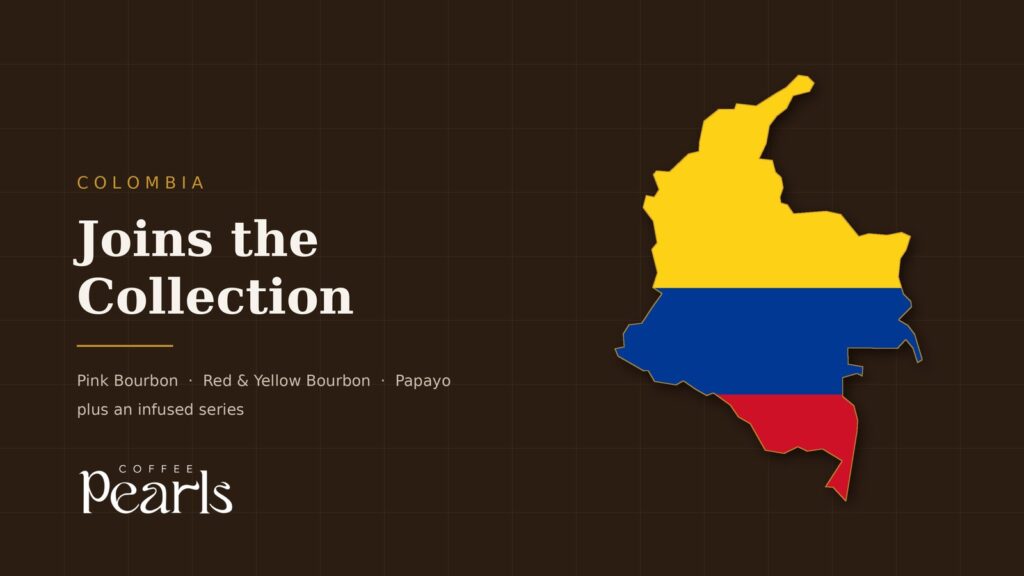
Since we started in 2024 we have said the same thing about Yemen. That the beans came first, that the terraces above Sana’a and Yafa’ and Haraaz hold something the rest of the world spent three centuries trying to copy, and that we would not dilute it.
We still believe every word of that. Which is exactly why we are going to Colombia.
Why we are not staying put
Follow the family tree of almost any coffee plant growing in the Americas today and it leads back to a Yemeni port. World Coffee Research records that French missionaries took the Bourbon variety from Yemen to Bourbon Island, now La Réunion, in the early 1700s, which is where the variety got its name. It reached Brazil around 1860 and spread north from there through South and Central America, until it reached the hills of Huila.
So when we put a Colombian Red Bourbon next to a Yemeni Kholani, we are not changing the subject. We are showing you two branches of the same tree, three hundred years apart, shaped by different soil and different hands.
That is the collection we are building. Not a shelf of countries. A family.
The four varieties
Red Bourbon. The classic. Round, sweet, structured. Bourbon and Typica are the two old branches that carried Yemeni coffee into the wider world, and Red Bourbon is the one still grown under its own name. Red Bourbon is what people mean when they say a coffee tastes like coffee should. If you drink our Kholani, this is the one to put beside it.
Yellow Bourbon. First recorded in 1930 near Pederneiras in São Paulo, on a Red Bourbon farm, where the cherry ripened to gold instead of crimson. Whether it arose as a spontaneous mutation or as a natural cross with the older Yellow Botucatu is still not settled, and we would rather say so than pick the tidier story. What is not in doubt is the cup: more sweetness and a softer acidity than the red. Gentle, honeyed, easy to love.
Pink Bourbon. The one with the best story in modern coffee, and it is a story about being wrong.
Pink Bourbon grows in Huila, produces a blush-coloured cherry that is neither red nor yellow, and was named a Bourbon for that reason alone. Then people tested it. DNA work published in 2017 and again in 2023 found no meaningful Bourbon genetics in it at all. What it carries are the markers of an Ethiopian landrace, one of the old, wild, undomesticated populations from coffee’s birthplace.
Nobody has established how it reached Colombia. It is simply there, growing under a name that turns out to be a lovely mistake.
We find that delightful, and not only because it is a good story. Coffee’s oldest material keeps turning up in places the textbooks did not predict. Anyone who has stood on a Yemeni terrace already suspected as much.
In the cup, Pink Bourbon is floral and bright and unusually layered. Jasmine, stone fruit, a long clean finish.
Papayo. The rarest of the four. Grown in small quantities in Huila, concentrated around Acevedo, with a little in Tolima and Quindío. It takes its name from the cherry, which is long and ribbed and looks like a small papaya.
Its parentage is genuinely unsettled. Some believe it is close to the Ethiopian landraces. Others think it may be a mutation of Pink Bourbon. World Coffee Research is careful to say that nothing is confirmed without wider genetic testing, and it is sometimes confused with Ombligón, another rare Huila variety that looks similar.
What is not in dispute is the cup. Papayo is tropical and loud in the best way. Mango, pineapple, papaya, stone fruit, a thread of spice. Washed, it turns toward caramel and dulce de leche. Natural, it leans into cherry.
It appears on competition tables far more often than it appears on shelves, because there is so little of it.
The infused series
Alongside the single origins we are bringing in a second line, and we want to be direct about what it is.
Infused coffees are made by introducing fruit, botanicals or other flavour material during fermentation and drying, so the character is carried in the bean itself rather than sprayed on afterwards. It is a modern Colombian speciality, and the producers doing it well treat it as a craft rather than a shortcut.
The flavours coming in are coconut, watermelon, grape, peach, whisky, piña colada, tropical, and passion fruit.
We know some of you will read that list and raise an eyebrow. We understand. For a house that has spent years arguing for the purity of single-origin Yemeni coffee, a watermelon-infused bean is a turn.
Here is our honest position. These are not for the morning you want to taste Haraaz. They are for the afternoon you want to be surprised, for the guest who says they do not like coffee, for the iced brew in July that tastes like a holiday. They sit beside the collection, not in front of it. Our Yemeni beans are not going anywhere, and nothing we source will ever be blended into them.
Try them the way you would try a dessert. With curiosity, not reverence.
How they will arrive
Colombian beans will come to you the way our best Yemeni lots already do, through a pre-order campaign rather than off a shelf.
We open a fixed lot. You reserve your share. Nothing is roasted until the lot is fully reserved and every participant has confirmed payment. Then the whole lot goes to roast on one date and ships immediately.
It means no warehousing, no blending with older stock, and no bag that has been sitting since a month you cannot remember. One lot, one roast date, straight to the people who reserved it.
It also means the rare ones sell out. Papayo in particular will arrive in very small quantity.
Be first to know
Pre-order campaigns open to our notification list before anything appears publicly. If you want a share of the first Colombian lot, register your interest on the pre-order page and we will write to you before it opens.
Yemen is where we started and where we will always belong. Colombia is where some of that coffee went, three centuries ago, and what it became in the meantime is worth tasting.
—
Sources
- Bourbon’s route out of Yemen, and the 1860 arrival in Brazil: World Coffee Research, Bourbon
- Yellow Bourbon, 1930 near Pederneiras, and the unresolved mutation-versus-cross question: Daily Coffee News
- Pink Bourbon genetics, DNA Analytica 2017 and RD2 Vision 2023: Café Imports
- Papayo origin, growing regions, unsettled parentage and cup profile: Perfect Daily Grind
Not sourced, and stated as our own view rather than fact: the description of how infused coffees are produced, and every judgement about how these coffees sit beside our Yemeni range.
Leave a comment